Limited Time Offer – Save 25%

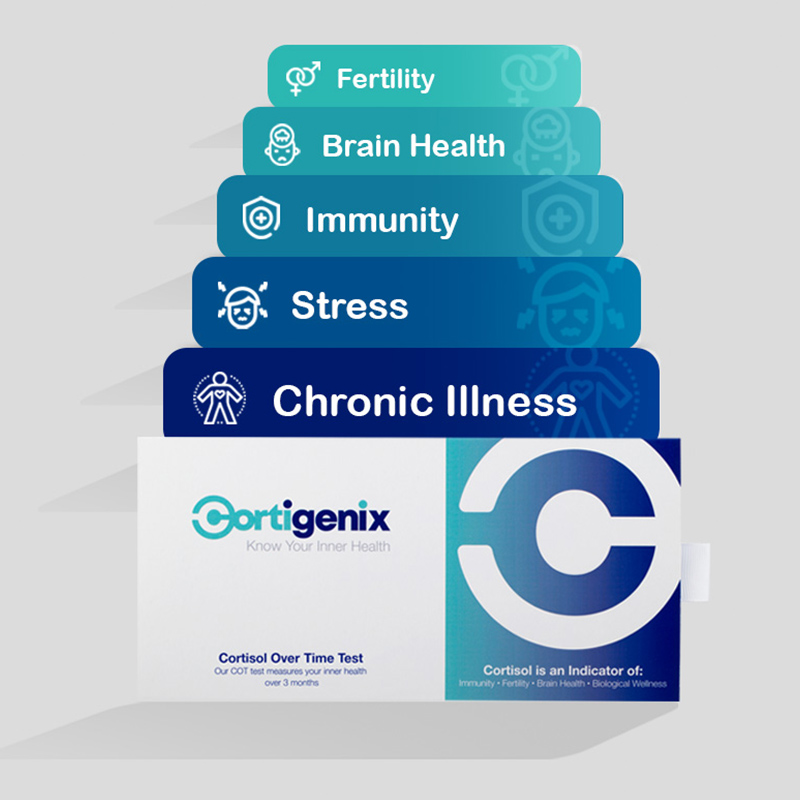
How chronic stress affects your health
Stress is a term we use in everyday life, but what is actually happening inside the body when we experience it — and what does cortisol have to do with it? Here, I want to explain what stress is, how it affects your health, and why measuring cortisol over time gives a more accurate picture than any single test.
What is stress?
There are many definitions of stress, and what one person finds stressful another may not. In general terms, stress can be thought of as an experience triggered by an event — past, present, or future — that an individual perceives as potentially threatening. This experience is part emotional, part cognitive, part behavioural, and part physiological.
Stress can be short-lived (acute) or long-lasting (chronic). Acute stress — a driving test, a job interview — is by definition transient and is not usually associated with negative health effects. Some research suggests it can even be beneficial. Chronic stress — unemployment, bereavement, caring for others — is more persistent and can result in physiological wear and tear referred to as 'allostatic load', with potentially serious consequences for health.
What happens in your body when you're stressed?
When we encounter a stressful situation, the body produces a cascade of physiological responses designed to give us the energy to 'fight or flight'. Two main systems are activated:
The first is the sympathetic–adrenal–medullary (SAM) system. When activated, breathing quickens, heart rate increases, eyes dilate, and non-essential processes like digestion are suppressed to redirect blood and energy to the muscles.
The second is the hypothalamic–pituitary–adrenal (HPA) axis. The hypothalamus releases corticotrophin releasing factor (CRF), which travels to the pituitary gland and stimulates the release of adrenocorticotrophic hormone (ACTH). ACTH in turn stimulates the adrenal glands to produce cortisol — the so-called 'stress hormone'.
How can chronic stress affect your health?
Decades of research have shown consistently that chronic stress can have serious consequences for health — both now and in the future. Stress affects health directly through internal physiological processes, and indirectly by changing health behaviours such as diet, sleep, and exercise.
Chronic stress has been shown to:
- Reduce how effectively your body responds to vaccines
- Impair recovery from surgery and illness
- Increase the risk of heart disease
- Affect fertility
- Impair brain health and cognitive function
- Accelerate ageing at a cellular level
How can measuring cortisol help?
One of the most insidious features of chronic stress is that we often don't recognise it when we're experiencing it. The changes in how we feel, think, and behave happen gradually, and we may not notice the effects on our health until significant damage has been done.
Measuring cortisol is one way to get early, objective insight into the level of stress your body is experiencing. Blood, saliva, and urine tests are the traditional options — but all of them share the same fundamental limitation: they only capture cortisol over minutes to hours. These snapshots can be misleading, because cortisol goes up and down in response to many short-term factors.
It is only when cortisol remains elevated for long periods of time — as in chronic stress — that the effects become harmful to health. A test that measures just today's level can't tell you whether that's been the case.
Measuring cortisol in hair solves this problem. Hair cortisol provides a cumulative record of your cortisol levels over several months — an accurate, reliable, and practical way to assess long-term hormonal exposure.
Empowering you to take control
Knowing how your body is responding to stress on the inside gives you a basis for taking action. Cortisol is a complex hormone — beyond its role in the stress response, it's also affected by diet, sleep, and exercise. This is good news, because it means that in addition to reducing your sources of stress, you can improve your cortisol levels through lifestyle changes. Small, sustained changes are often more effective than large, short-lived ones.
If you have questions about stress and cortisol, you can reach us at support@cortigenix.com.
Ready to check your cortisol levels?
One hair sample. A 3-month average. Results in your secure dashboard within 10 days.
Order your test – £126.75References
O'Connor, D., Thayer, J., and Vedhara, K. (2020). Stress and Health: A review of psychobiological processes. Annual Review of Psychology, 72, 4.1–4.26.
Greff, M. et al. (2019). Hair cortisol analysis: An update on methodological considerations and clinical applications. Clinical Biochemistry, 63, 1–9.
Lovallo, W. R. (2016). Stress and Health: Biological and Psychological Interactions. 3rd ed. SAGE.
Segerstrom, S. C. & Miller, G. (2004). Psychological stress and the human immune system: a meta-analytic study of 30 years of inquiry. Psychological Bulletin, 130, 601–630.
Raul, J-S. et al. (2004). Detection of physiological concentrations of cortisol and cortisone in human hair. Clinical Biochemistry, 37, 1105–11.