Limited Time Offer – Save 25%

Hair Cortisol Test for Fertility
When you're trying to conceive — or preparing for IVF — cortisol is a factor that often goes unmeasured. Research published in peer-reviewed journals shows that sustained elevated cortisol reduces the likelihood of successful conception and is associated with worse IVF outcomes.
The critical word is sustained. A blood test taken on the morning of your embryo transfer only reflects that morning. Hair cortisol tells you what your hormonal environment has actually been like for the past three months — the window that matters most.

No blood. No needles.

Quick, easy at-home collection

Free UK postage

Single sample — no repeats needed

Clinically proven with expert support



About this test
Sample method: Hair | Measurement window: 3 months
Cortigenix's Cortisol Over Time (COT) test measures your average cortisol over the past 3 months. Multiple peer-reviewed studies have found that hair cortisol levels — but not saliva or blood cortisol measured at a single point — predict IVF success rates. The researchers' conclusion is consistent: it's the sustained cortisol environment, not the reading on any given day, that matters.
This test is also valuable for anyone trying to conceive naturally. Cortisol suppresses reproductive hormones including oestrogen, progesterone, and LH, and can disrupt cycle regularity. Understanding your long-term cortisol status gives you a clearer basis for any lifestyle changes you're considering to support your fertility.
References: Massey et al. (2016), Psychoneuroendocrinology; Massey et al. (2014), Reproductive Medicine and Biology.
Signs cortisol may be affecting your fertility
These symptoms can overlap with other hormonal issues, but sustained cortisol elevation is a common underlying factor:
- Difficulty conceiving after several months of trying
- Irregular periods or changes to cycle length
- History of or concern about IVF outcomes
- Chronic fatigue
- Low mood or anxiety
- Disrupted sleep
- Brain fog
- Recurrent infections
- Low libido
- Unexplained weight changes
- Headaches
- Nausea or digestive issues
Who should take this test?
- You are trying to conceive naturally and want to check whether cortisol may be a factor
- You are preparing for or have previously undergone IVF
- You want a 3-month cortisol baseline before a fertility treatment cycle
- You have irregular cycles and suspect stress hormones may be involved
- You've been under sustained stress and want to understand its impact on reproductive health
- You want objective data to support discussions with your fertility specialist
Why hair testing gives a clearer picture
Blood, saliva and urine tests capture cortisol at a single moment. But cortisol fluctuates constantly — by the hour and by the day — meaning a result on a calm morning can look completely different to one taken during a stressful week. A single snapshot can lead to results that are misleading or missed altogether.
Hair cortisol testing works differently. As hair grows (~1cm per month), cortisol from your bloodstream is incorporated into the hair shaft. Analysing the section closest to the scalp gives a reliable, averaged picture of cortisol exposure over the past three months — unaffected by whether you had a bad night before the test, or exercised that morning.
It's the same principle as an HbA1c test for blood sugar: one measurement that reflects sustained exposure over time, not just today.
Hair vs other cortisol tests
Other cortisol tests only measure where your cortisol sits at a single moment. But cortisol changes minute by minute — which is why a one-off blood test can miss the full picture. Hair cortisol testing works like an HbA1c for blood sugar: it gives you a reliable average over three months, not just a snapshot of today.
| Feature | Hair test Cortigenix | Blood test | Saliva test | Urine test |
|---|---|---|---|---|
| Measures cortisol over 3 months | ✓ | ✗ | ✗ | ✗ |
| Single sample — no repeat testing needed | ✓ | ✗ | ✗ | ✗ |
| Unaffected by acute stress on test day | ✓ | ✗ | ✗ | ✗ |
| Detects chronic (long-term) cortisol patterns | ✓ | ✗ | ✗ | ✗ |
| No needles or clinic visit required | ✓ | ✗ | ✓ | ✓ |
| Suitable for at-home self-collection | ✓ | ✗ | ✓ | ✓ |
| Results unaffected by time of day | ✓ | ✗ | ✗ | ✗ |
| Validated by peer-reviewed research | ✓ | ✓ | ✓ | ✓ |
| Useful for diagnosing adrenal conditions | ✓ | ✓ | ✓ | ✗ |

After two unsuccessful IVF rounds I started looking at what else I could change. My consultant mentioned cortisol as a possible factor. This test confirmed my levels had been elevated — I've since made changes and feel much more in control going into the next cycle.
K Hartley
Really easy to use, and the results dashboard was much more detailed than I expected. Gave me something concrete to take to my doctor rather than just a vague sense that stress was affecting things.
L Pearce
How it works
No clinic visit. No needles. Everything by post, all from home.

Step 1
Order your test kit
Step 2
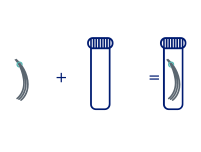
Take a small hair sample at home
Step 3
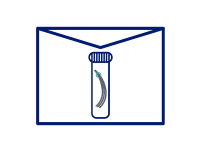
Post your sample using the prepaid envelope

Step 4
Receive results in your secure portal within 10 days
Sample: A small hair sample from the back of your head — minimum 1cm in length, about 8–10 strands thick. Full instructions included in your kit.
Still have questions?
What is cortisol?
Cortisol is a hormone often called the 'stress hormone' because of its role in helping the body respond to stress. It regulates a wide range of functions: immune response, metabolism, reproductive health, blood pressure, and brain function. Every cell in the body has cortisol receptors, which is why prolonged imbalance — whether too high or too low — can affect so many aspects of your health.
Why measure cortisol over 3 months rather than with a single blood test?
Cortisol fluctuates constantly — it varies by the hour and can spike significantly on a stressful day. A single blood, saliva or urine test only captures a snapshot of one moment, which means a 'high' or 'low' result could simply reflect the circumstances of that morning.
Measuring cortisol in hair provides a reliable average over the past 3 months, in the same way an HbA1c test measures average blood sugar over 3 months rather than a single glucose reading. This makes it far more useful for assessing chronic stress, adrenal health, and long-term cortisol patterns.
Why does this test use hair rather than blood, saliva or urine?
Hair is a stable, long-term record of cortisol exposure. As hair grows (roughly 1cm per month), cortisol from the bloodstream becomes incorporated into the hair shaft. Analysing the section closest to the scalp gives a precise, averaged view of cortisol levels over the preceding three months.
Blood, saliva and urine tests are affected by acute stress, time of day, exercise, and medication taken before the test. Hair cortisol is not — making it a more objective and reproducible measure of your true long-term cortisol status.
What is the science behind Cortigenix's test?
Hair cortisol testing is backed by decades of peer-reviewed research and is used by scientists at institutions including the University of Oxford, King's College London, Harvard University, and the University of Auckland. Our test has been independently validated using data from thousands of participants. Research partners include the University of Nottingham, University of Auckland, and King's College London.
Is your test available worldwide?
Yes. We ship to over 170 countries. UK orders include free postage. International shipping rates are calculated at checkout.
How much hair do I need to provide?
You need a small sample from your head — a minimum of 1cm in length and approximately 8–10 strands thick (around 2–3mm). Full instructions are included in your kit.
Where should I take my sample from?
We recommend taking your sample from the back of your head, near the cranial bone (the bump you can feel at the base of your skull). This area tends to give the cleanest, most consistent results and the sample is not visible once taken.
Will hair dye or treatments affect my results?
No. All hair samples are thoroughly washed before analysis to remove external contaminants, including dyes, bleach, conditioner, and styling products. Your results will not be affected.
How are my results delivered?
Results are delivered to your secure personal dashboard within 10 working days of your sample arriving at our laboratory. You'll receive an email notification when they're ready. If your results are outside the normal range, one of our cortisol experts will be available to discuss next steps.